energy news | ethanol | cellulose | algae | agriculture | biodiesel | oil/gas | wind | alt energy | carbon credits
Renewable Diesel | (various)
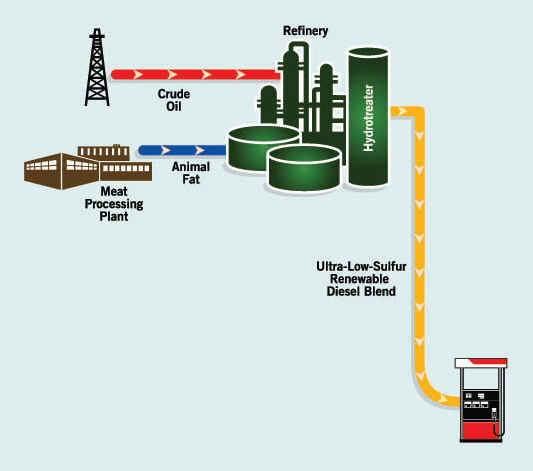 Renewable diesel is a fat-based, new fuel type that has the backing of and has been developed by the oil industry.
Developed initially by Conoco Philips in conjunction with Tyson Foods, it apparently can be produced in conventional, existing oil refinery facilities. Further, as they claim that renewable diesel is chemically equivalent to petrochemical diesel, it may not have the temperature-related clouding issues that challenge biodiesel.
So far, little has been disclosed about their “proprietary thermal depolymerization process” and the percentage of animal fats that are represented in the final bio/petro fuel mix.
CP & Tyson say that their venture could be producing 175 mgy by 2009, or 10% of the projected biodiesel market. Tyson feels that this business could contribute between $.04 and $.16 EPS.
- NREL’s overview of petroleum and biodiesel lifecycles
- Conoco chart
GS CleanTech Executes Agreement with Ethanol Producer to Extract Corn Oil for Conversion into Biodiesel
GreenShift Corporation - Press Room - GS CleanTech Executes Agreement with Ethanol Producer to Extract Corn Oil for Conversion into Biodiesel
US Canola Growing | (various sources)
U.S. Canola Association -- Welcome to the U.S. Canola Association
Map of Canadian canola farming
Economist article on canola & soy
Louis Drefus Corp to build 80mgy Plant in Indiana | autoblog
French company building world's largest biodiesel plant in Claypool, Indiana -
Consumer Biodiesel Fansites
BIODEZL Home Page (includes list of biodiesel outlets in CA and NV)
Fred's TDI Club (instructions on how to run biodiesel in a VW diesel
Biodiesel, Biofuel, Biodiesel Fuel, blue sun biodiesel
Biodiesel, Biofuel, Biodiesel Fuel, blue sun biodiesel
- Alamosa, CO blender was built to service output from a Blue Sun plant that was never built.
Biodiesel Used to Degrade Waste Plastics | AgriNews
West Central Cooperative (Ralston, IA) and General Atomics (San Diego) are sharing a $3.3 mil fed grant to study whether biodiesel can with waste disposal while also fueling trucks and equipment. West Central is one of Iowa's largest farmer coops. General Atomics is a division of General Dynamics.
US to Decode Soybean DNA to Aid Biodiesel Production | Environment News Services
Jointly funded by the Ag Dept and Dept of Energy, the Joint Genome Institute in Walnut Creek, CA, will be the lead facility.
George Monbiot on Biodiesel
Monbiot has a regular column in the Guardian (UK) and has recently taken on biodiesel. Two separate articles
Feeding Cars, Not People - mostly theoretical discussion of how the diversion of farm land to production of oils for biodiesel risks cutting into production of foods.
Worse Than Fossil Fuel -
Biodiesel - Reference Info
Plant Designers/Operators
- Lurgi PSI – They are builders of biodiesel plants in Europe, five of them at least, including one for Cargill. They are also the builder of one of Panda’s ethanol plants, in Hereford, TX. Lurgi PSI is the NA div of Lurgi AG, which is itself a subsidiary of GEA Group AG (Global Engineering Alliance). Lurgi is a world leader in the design & building of systems that produce bio-gas, as well as coal gasification. [? Do they have an IP to counter E3?]
Players
- BASF – they make sodium methylate (yields crude glycerine) and potassium methylate (yields higher pharmaceutical grade glycerine), catalysts. Each are an alternative to sodium hydroxide, providing higher yields of both biodiesel and glycerine (at a higher cost presumably?).
Types of alternative diesel fuels
- B20 – Mixture of 20% biodiesel and 80% petroleum diesel. 20% is the maximum amount that can be burned in most diesel engine without modification; many engines will allow the use of higher blends or even pure biodiesel without any modification. B20 is used by the US military (the largest US user of biodiesel (2005)).
- B100 – 100% biodiesel – engines generally require some modification in order to be able run this type of fuel. It has a much higher flash point (safer to store), lower harmful emissions. Conflicting info on its power & efficiency characteristics.
- E-Diesel – A fuel still under development, it uses additives (up to 5%) to allow ethanol (between 7-15%) to be added to normal petroleum diesel.
- Low sulfur diesel (not a bio-diesel) – the EPA is forcing the introduction of that cleaner burning form of petroleum diesel onto the market, beginning in 2006. As sulfur provides for lubricity, the loss creates a problem that biodiesel can rectify. It is, however, not the cheapest additive that can be used to solve that problem.
Recipe:
65-75% of cost is animal fats or vegetable oils. 4-6% of additional production costs come from the alcohol source & a base catalyst
Fats & Oils that can be used:
- Oils: soybean, corn, cottonseed, sunflower, canola (aka rapeseed)
- Fats: beef tallow, choice white grease, yellow grease (used frying oil), chicken fat
* Animal fats & used cooking oils generally have higher levels of FFA, MIU and titer (low is better). This makes them more difficult to process and yields diesel fuel that gels more quickly in cold temperatures. When they are used, it is for their lower cost and/or local availability.
Industry Groups
- National Biodiesel Board (biodiesel.org, publishers of Biodiesel Magazine) – includes this Biodiesel Fact Sheet
- Canadian Renewable Fuels Association
- National Renewable Energy Lab
- Biomass Program - US DOE – Energy Efficiency & Renewable Energy
Government
Finance/Costs
Plant cost - $12 mil for 15 mgy (2002 estimate – Independent Biodiesel Feasibility Group)
Technology
3 routes to production:
(a) base catalyzed transesterification of oil with methanol (most common method)
(b) direct acid catalyzed esterification of oil with methanol
(c) conversion of the oil to fatty acids, and then to methyl esters with acid catalysts.
Feasibility:
5 question:
- What raw materials will you use? Can you get enough? At what price?
- Can you meet the ASTM quality test (ASTM D 6751)?
- what technology is best for the feedstock of choice? (or, where is the best place to locate for your chosen technology?)
- do you have a market for biodiesel? At what price?
- do you have a market for glycerine (the co-product) or do you have to pay to give it away?
News/Opinion/Blogs
- Oregon-based blog B100
Additional reference info to review:
http://www.harvestcleanenergy.org/enews/enews_0505/BiodieselPlunge.pdf - time to take the biodiesel plunge
http://www.ewg.org/reports/Slickers/appendix1.html?print_version=1 – background on federal farm subsidy programs
Demand Profile
Current demand in US
- The biggest bio diesel customer in the US is the US military [source: Wired]
Current European demand
- 2,000 stations currently serve B100 biodiesel in Germany. Oil companies are already adding it to regular diesel (B5 formulation). [source: Lurgi AG]

