November 08, 2007
November 01, 2007
SAE Energy
Wichita, KS - based
- small scale conversion business
- multiple fuel & engine type experience
- including Neil Young's Linc-Volt conversion of a '60 Lincoln Continental Mk IV to biodiesel-fueled series hybrid capabilities. He anticipates 100 mpg
Press
- Fast Company (Nov 2007)
- AutoblogGreen (10/20/07, 10/27/07)
October 31, 2007
QTWW: Quantum Fuel Systems Technologies Worldwide
Irvine, CA - Alan P. Niedzwiecki (president)
Projects & Development Partners:
Fisker Automotive Inc. - This press release indicates that this is a JV between Quantum and Fisker Coachbuild LLC.
- development partner with Fisker Automotive on their plug-in hybrid sport sedan. QTWW is developing the chassis and will perform development, testing and regulatory work for the $80,000 car.
- initial announcement with picture
US Army - hydrogen hybrid for TARDEC - Ltd volume (6 units) of converted Ford Escapes.
Asola - Advanced & Automotive Solar Systems GmbH - made a 25% investment (or a May 2007 LOI to do so). They make the solar panels that are installed in Audi (and others) sunroofs to power parked A/C systems and also charge batteries (buses, trucks).
October 16, 2007
Wrightspeed: I want to make a series-hybrid HD pickup
You don’t often hear 'hybrid' used in the same sentence as heavy duty pickup, but if alt-power entrepreneur Ian Wright has his way, that's about to change.
Mr. Wright is the founder of Wrightspeed, a company dedicated to developing an electric car, called the X1. The X1 prototype (pictured above) is a proof-of-concept along the way to a practically produced roadster that will be capable of outrunning most of the world’s fastest petrol-powered supercars. The prototype can zoom 0 to 60 miles-per-hour in 3-seconds with a 100-mile battery range.
But it's not the hoontastic goal of having a speedy, battery-driven two-seater that’s driving Mr. Wright. That kind of car won’t save the planet.
If you want to make a dent in oil dependence and CO2 emissions, you need to target the vehicles that make up the biggest portions of those items. To Mr. Wright, that means pickup trucks.
Mr. Wright isn't picking on pickups. The native New Zealander proudly owns a used 1997 Ford F-350 7.3-liter diesel dually Super Duty that he uses to haul lumber, 12,000-pounds at a time, to a saw mill on his personal property. The truck has 178,000-miles on the odometer.
"If you want to do something about oil consumption, you can't ignore pickup trucks. The numbers in the U.S. go something like this: 69% of the oil we use is for transportation. 81% of that is highway transportation. Only 9% is air and 5% is marine. Rail doesn't count for much, only about 2%. If you look (more closely) at highway transportation, about 95% is trucks and high fuel consumption cars. Then, if you look at the truck portion only (about 57% of highway oil consumption), 95% of truck sales have 14,000-pound gross vehicle weight ratings or below [Classes 1, 2, or 3]. Big rigs are only around 250,000 out of 8,000,000 trucks sold. (Big rigs) do a lot more miles, but the fleet population is low. And big rigs are pretty good loaded on a gallons per pound/mile basis. An 80,000-pound big rig does well (fuel economy-wise). What aren't good are the pickups we drive. When I'm towing 12,000-pounds, it's not bad on a gallons per pound/mile basis, but when I drive it to work with just me in it, it still doesn't do better than 14 miles-per-gallon. Three out of the top five selling vehicles last year in the US were full size pickups, so pickups are a big opportunity to save oil for the US, because, to a first approximation, that’s what people drive and to a first approximation, that's where all the fuel goes," describes Mr. Wright, outlining his position for focusing on pickup truck fuel efficiency.
Mr. Wright's solution to the low fuel economy ratings of pickups is to design a hybrid electric powertrain. The alternative engine technology developed would be licensed or built in cooperation with a third party supplier and sourced to the truck manufacturers during assembly.
Hybrid powertrains come in three flavors: parallel, two-mode, and serial.
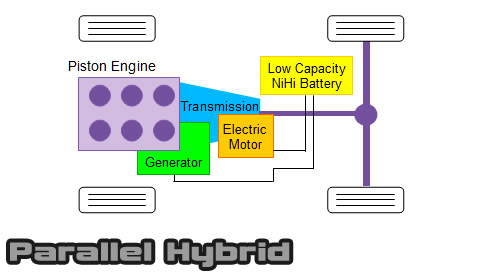
Parallel hybrids are powered by an electric motor, an internal combustion engine, or both at the same time. General Motors used a parallel powertrain in the discontinued ‘mild’ hybrid GMT 800 Chevrolet Silverado. The truck shut its gas V8 engine off at full stops, running internal systems off a small electric motor, until the truck started moving again solely on V8 power. Toyota uses a parallel system too, for its Hybrid Synergy Drive cars, like the Prius and Camry. It's a sophisticated version of parallel technology, where the electric motor or conventional engine solely powers or moves the vehicle, or both motors work together, depending on engine load conditions. But parallel hybrids only swap or pair engines in low-speed driving conditions, like city traffic, so they are also called single-mode hybrids.
Two-mode hybrids use an advanced automatic transmission that determines whether to use an electric motor or the conventional engine, or both at the same time during low-speed and highway driving - which is why it's called two-mode. This allows the vehicle to behave like it had a continuously variable transmission (CVT) so it can achieve optimal fuel economy at all times while driving. GM’s new GMT 900 Chevrolet Tahoe SUV uses a two-mode hybrid powertrain because the system doesn't compromise much of the vehicle's all-around capabilities. It can still tow up to 6,000-pounds, only 1,000-pounds less than a conventional Tahoe. We'll see a new Chevrolet Silverado two-mode hybrid pickup by December 2008.
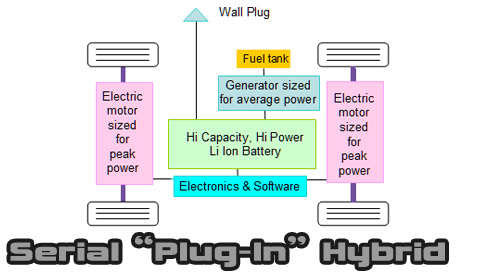
Series hybrids use an electric motor to drive the wheels, while a conventional (e.g. diesel) or non-conventional (e.g. fuel cell) engine powers a generator. The generator either powers the electric motor directly, like a locomotive, or is used to charge a battery pack, which powers the electric motor. Using a battery in a serial hybrid does three things. Batteries can be plugged into the energy grid for recharging, making the vehicle a 'plug-in' series hybrid, like GM's Chevrolet Volt concept. Batteries enable driving for some distance without burning fuel, and they let the generator engine run only at its most efficient point, and any time the generator is running it’s charging the battery. This is unlike an idling locomotive, stopped at a train station and burning fuel without purpose.
The advantage of a serial hybrid over the parallel and two-mode versions is that, within the battery’s charge range, the vehicle is emitting zero exhaust and not using any oil. It also has fewer moving parts, even counting the generator, which means less vehicle maintenance and lower lifetime operating costs.
Mr. Wright favors the plug-in serial hybrid approach for heavy duty pickups.
"The Volt is where it's all going to go, eventually. It's the right development path. Of course, it doesn't have enough power (for a truck). It would be great if it had enough scale for a pickup truck," says Mr. Wright.
It's one thing to power a small family sedan, like the Chevy Volt, off a serial hybrid powertrain. But the large size and demanding power requirements of heavy duty pickups make it a more challenging proposition for use in a truck application.
"My guess is that you can make a serial (hybrid) heavy duty pickup that weighs the same as a conventional diesel powered pickup. Its configuration will depend on how far you want to go with plug-in power versus how long you want to sustain power climbing a 15% grade towing 20,000-pounds, as to how you size the generator and the batteries. If you use a bigger generator, you can trade-off with a smaller battery pack," says Mr. Wright.
To limit the need for a bigger generator, the truck’s chassis would be redesigned to squeeze more batteries around the bed. The live axle and leaf springs would be chucked in favor of an independent rear suspension, reclaiming wasted space beneath the cargo box.
Heavy duty pickup owners care as much about range as they do towing capacity, so they don’t have to make frequent fuel stops hauling a trailer. Mr. Wright believes his system would provide at least a 300-mile range, with the same weight and towing capacity as current trucks.
"If you’re going to build (plug-in serial hybrid) heavy duty trucks to compete with the current ones, you can’t compromise on (towing, weight, and range)," says Mr. Wright.
Where compromise would occur is in the purchase price. A serial hybrid pickup won’t be cheap, costing an estimated $20,000 or more than a conventional diesel powered truck.
"Cost is going to depend on the price of fuel. If fuel is $4.00/gallon and you’re driving 25,000 miles per year, and you’re getting 10-mpg towing, that’s $50,000 over five years. If you did the same thing with a plug-in hybrid, using only grid power, it would be about $6,000. That means you could afford to pay quite a bit more for the vehicle," says Mr. Wright. He also expects a hybrid’s lower maintenance costs to also provide further economic incentive.
But to Mr. Wright, the thing that makes pickup trucks such a good target is that most of the time they operate well under their maximum rated power.
"That’s not an efficient way to build a car," he says. "You need to have the peak power to tow and accelerate, but most of the time you don’t use it. Cylinder deactivation is one way of getting at the problem but it doesn't nearly solve it."
The electric motors and batteries would operate optimally across a wide range of power needs, from the equivalent of as little as 20-horsepower during 40-mph unloaded, steady state driving, to as much as 1000-hp for brief periods climbing a steep grade with a 20,000-lbs trailer.
It all comes back to fuel economy though, and Mr. Wright thinks poster-child green-tech vehicles like the Toyota Prius are a dead-end compared to pickups.
"Consider just one 10-mpg truck and one 50-mpg Prius," he says. "Drive them both 100-miles. The truck uses 10-gallons, the Prius 2-gallons. Improve the Prius to 100-mpg, drive another 100 miles. Now it only uses 1-gallon, you saved 1-gallon. But improve the truck by 12%. Now it does 11.2-mpg, and in 100-miles it will use 8.9-gallons, an improvement of 1.1-gallons. If you doubled the trucks mpg, from 10 to 20, you'll save 5-gallons, 5 times as much as doubling the mpg of the Prius."
Mr. Wright is predicting his approach will deliver fuel economy that's close to double today’s figures while towing, and the equivalent of 80-mpg during unloaded, stop-and-go, commute-style driving.
"When you compound this effect with the higher sales volume of high fuel consumption vehicles like pickups," he says, "you can see why it's completely pointless to improve the Prius, and crucial to improve the trucks."
October 11, 2007
Design Line
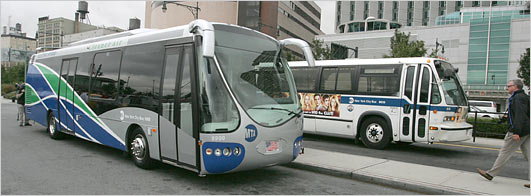
- North Carolina-based company, New Zealand manufacturing
- supplier of turbine/hybrid buses to NYC
- turbines supplied by Capstone Micro
ISE Corp
- Maker of ThunderVolt Hybrid Drive Systems
- Series hybrid architecture for large vehicles (bus, truck, military)
- hybrid systems paired with gasoline (Ford V10), diesel (Cummins 5.9), hydrogen (Ford V10) and fuel cells (prototypes only)
September 07, 2007
EEStor / ZENN Motors | (various)

Developer of a some sort of high capacity, higher performance ultracapacitor. Based in Texas, they have money from Kleiner Perkins, and also from one of their customers, ZENN Motors (Toronto). ZENN has announced a new car with a 500 mile range.
Right: Ian Clifford, CEO of ZENN with his 2.22 electric car.
IHT article (from AP) - Sept 2007
April 19, 2007
EVC (Electric Vehicles Corp)
- $79 purchase from ZAP Motors
Cursory online info available, ltd to the following:
- info on some amplifiers for stepper motors and one H. S. Sandhu
- Champaign, IL address
April 17, 2007
April 09, 2007
March 21, 2007
Energy Efficiency & Emissions
 How does an electric car really compare to a normal ICE car? Using "well-t0-wheel" analysis, engineers have set out to objectively compare different approaches to mechanized transportation.
Factors
- power plants are inherently more efficiency that single automobiles
- amount of electricity required will vary significantly between vehicle type (e.g., an electric scooter will require far less current than a Tesla sports car).
Reference
- GREET model from Argonne National Labs (Greenhouse gases, Regulated Emissions, and Energy use in Transportation)
- Tesla's Energy Efficiency presentation - Their conclusions, for similar miles driven. A Tesla is about 40% more efficient than a Prius in terms of energy used. - Mechanical Engineering magazine - definitely not a big fan of all-electrics
February 06, 2007
Scuderi engine - hybrid air
Internal combustion engine that captures air and exhaust energy. From autobloggreen.com and their site.
January 31, 2007
Zap
ZAP-X:
- Zap will sell electric version of Lotus' aluminum CUV, the APX
- Latest drawings released (Mar 2007)
Business
- $79 million sale announced, to EVC (Chgo)
July 27, 2006
July 26, 2006
Exclusive Q & A with Elon Musk on the Tesla Roadster and the future of EVs | AutoblogGreen
Exclusive Q & A with Elon Musk on the Tesla Roadster and the future of EVs - AutoblogGreen ***
In depth interview, complete with some interesting details about the car. For instance...
- the battery pack has arranged the individual cells in "blades" or groups that can be replaced in case of substantial failure (owners/tesla do not have to worry about replacing either individual cells or the entire 6,801 cell pack).
- data is provided to compare total energy used by electric cars (with electricity from the grid) compared to both normal and hybrid gasoline cars.
July 21, 2006
PML MINI QED boasts 640 in-wheel electric horsepower - Autoblog
PML MINI QED boasts 640 in-wheel electric horsepower
- Another approach to electrics...the motors are integrated directly into the wheels, 160hp at each wheel. Additionally, this car uses ultracapacitors in addition to batteries.
July 20, 2006
Power Electronics Systems
Center for Power Electronics Systems
- discussion of "integrated PES" (IPES) systems
July 19, 2006
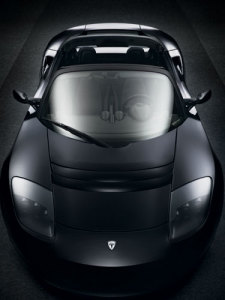
Tesla
Interviews
- Martin Eberhard (Mar 2007 autobloggreen) includes:
- reasons for choice of Lotus, including some denial about the Tesla being derived from the Elise
- changed suppliers and specs on the transmission
- testing: focused on safety & durability
- claims that battery degradation over time is minimized by their software and charging systems, and rationalization for why they are not doing anything to improve startup time in cold weather performance.
- implied changes to design for carrier for battery pack
- info on White Star sedan project, including
- the much-increased complexity required for the car and all of the new engineering people required
- explanation that rear drive is much more easily possible with an electric car because of the ultra-compact size of the motor
- parts supplied will be coming from traditional auto industry parts companies
- sales through Tesla-owned showrooms
- export plans/goals - too complicated for them to rush into
- battery technology - slam on altairnano, half the energy density and range.
News
- Less than 250 mi range (Apr 2007) - AutoblogGreen
- Launch (July 2006)
Wired News: Battery-Fueled Car Will Smoke You
Wired gets the honor of publishing the first test drive (or ride). More pictures here
June 23, 2006
May 17, 2006
Altairnano (Reno, NV)
Altairnano is a nano company, supplying modified raw materials to companies like Advanced Battery Technologies (batteries for cars), and others for other apps.
A123 Systems (Watertown, MA)
A123 Systems - Founded in 2001, they have licensed IP from MIT regarding nanoscale electrodes. The nanoscale advances yield improvements in density, safety and charge time.
On their site, they reference manufacturing through a variety of facilities in the US, China, Korea and Taiwan (combined 100,000 sq ft).
ZAP (zero air pollution)
Welcome to zapworld.com!
- seller of electric scooters, motorcyles, ATVs and cars like the ZAP Xebra, as well as legal importer of SMART cars.

Batteries 2006 (Paris)
Batteries 2006
- 3-day conference is primary event for Europe's battery makers
- Profile of 2005 attendees
Advanced Battery Technologies, Inc. (ABAT)
Main website
Altair Nanotechnologies to supply 2,200 lbs of lithium titanate spinel electrode nanomaterials. (from 10Q: ABT is a holding company with one subs, Cashtech Investment Ltd (Brit VI); Cashtech has one asset, which is 70% of the capital stock of Heilongjiang ZongQiang Power-Tech Co., Ltd. (ZQ Power-Tech, a Chinese LLC). ZQ designs, manufactures and markets rechargeable PLI batteries. Of their 1,200 employees, 120 are engineers and 49 are researchers with advanced degrees. Until Dec 2004, most funding came from Zhiguo Fu (the chairman).
Claims to have 25% of PLI (polymer lithium ion) market for IT & communications devices (2005).
ZAP (Santa Rosa, CA) has signed (04/28/06) an agreement to use ABT PLI batteries in their electric 3- and 4-wheel vehicles.
May 16, 2006
Lithium PT Cruiser taxi cabs planned for NYC - Autoblog
Lithium PT Cruiser taxi cabs planned for NYC - Autoblog
Hybrid Technologies, Inc
PTCruizer site (fan site)
May 09, 2006
Hey, Detroit, Wanna Drag? | Business Week
On the different approach being taken by Tesla and Wrightspeed.
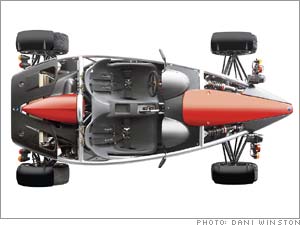
The Ariel Atom
The UK-based chassis supplier for the X1 (normally powered by a Honda 4-cyl, to even higher performance levels).
Wrightspeed (maker of X1)
Wrightspeed Inc.
- founded by Ian Wright - was lead engineer at Tesla in first year
- X1 - Based on the UK-based Ariel Atom - Originally announced as a production car, the company has decided not to produce it, and instead concentrate on what comes next. In its finished one-off prototype form, it has a 538 lb lithium ion battery pack, hits 0-60 in 3.0 seconds, has a range of 100 mi and can be recharged in 4.5 hrs (probably with a high voltage connection). (Fortune article)
Next
- $200,000 plug-in, series-type hybrid - article indicates diesel-power for the charging system.
- pickup - series hybrid conversion of current models
